
March 12, 2026 · active
Realm & Board
RTS-chess hybrid built in a weekend with AI. What happens when a game designer who can't code directs an AI that can.
Why this exists
Realm & Board was an experiment: how fast can you make something to test if it’s fun? Four hours of actual sat-down work over a weekend. Most of that time was designing the documents: game rules, stack selection, what the actual experience would be. The AI wrote the code.
The idea: what if you took chess and let players bring any pieces they wanted? But how do you decide what pieces people are allowed? So I threw an RTS into the mix and watched what happened.
What it looks like
The pieces
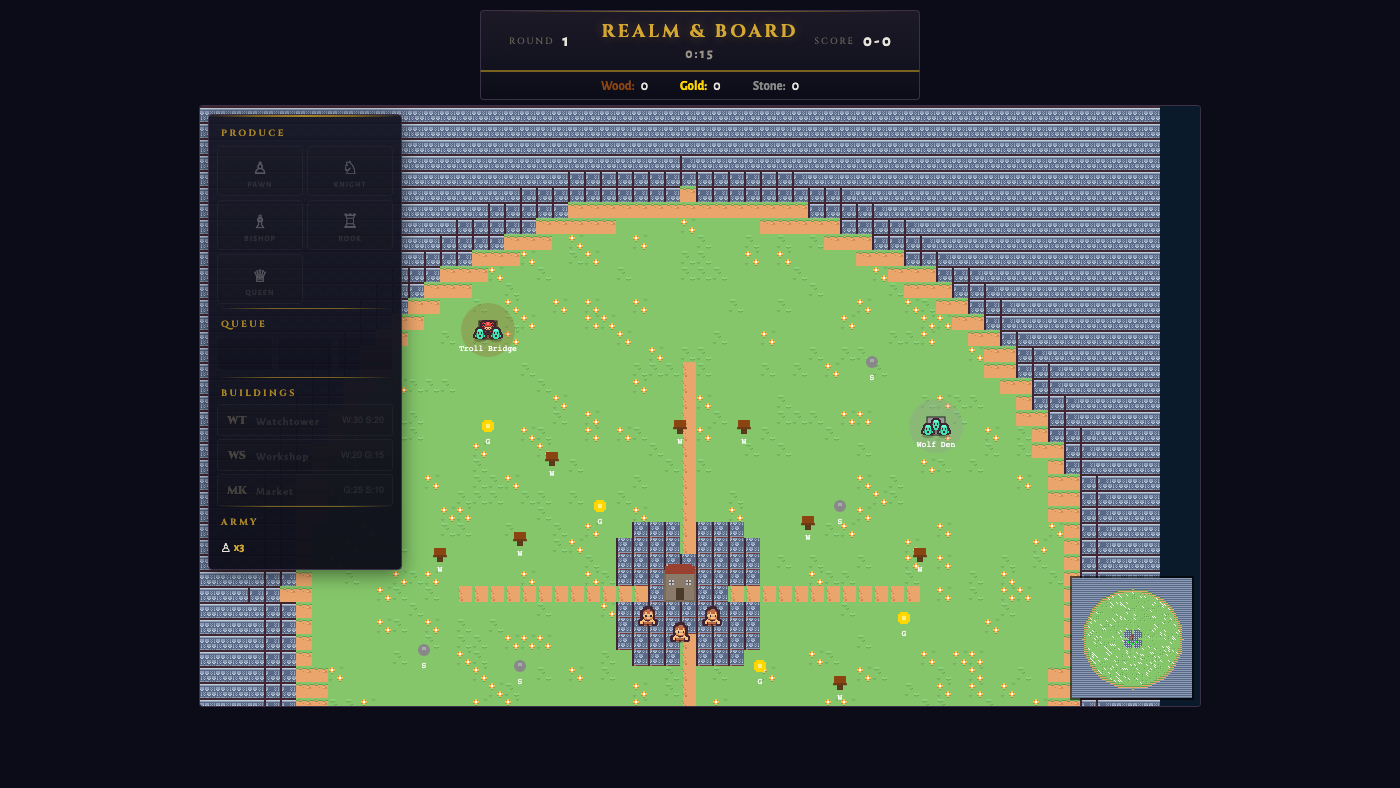
The island: RTS phase. 90 seconds. Gather resources, produce pieces, clear enemy camps. Pixel art terrain. The deeper you go, the richer the rewards and the tougher the enemies. Risk and reward escalate together.
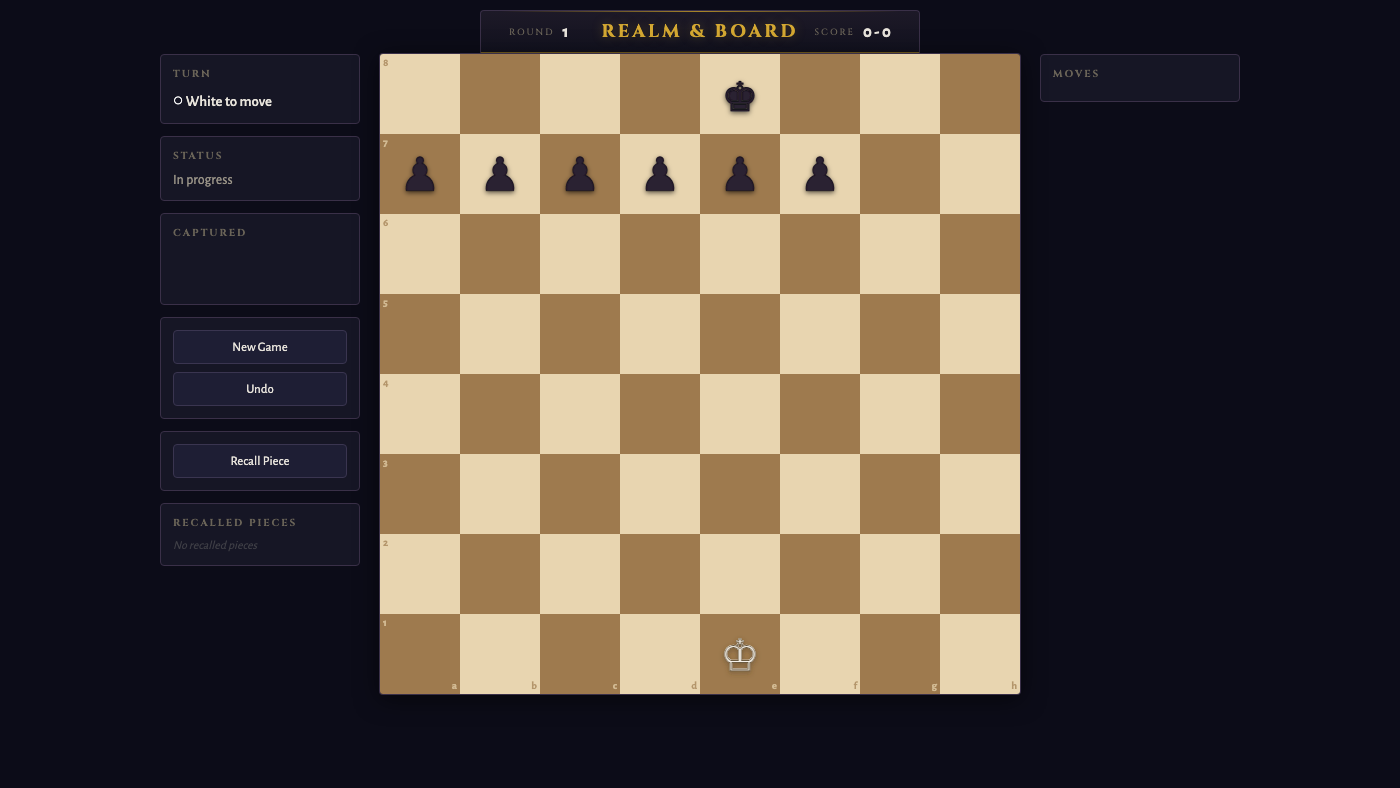
The board: chess phase. Standard chess rules. Custom placement lets you position produced pieces anywhere on your back two rows. A recall mechanic lets you swap a piece mid-match, but only if you produced it during the RTS phase.
The dilemma. Every pawn is a decision. Promote it to a queen, or keep it as a worker to feed your economy. The RTS phase doesn’t decide the match, but it decides what you can bring to it.
What surprised me
I come from a game design background. I’ve worked on games. But I am not a game developer. I can’t implement pathfinding. What I do have is the principles: raycasting, when to recalculate, vision areas, architecture. Because I could guide the AI in the right direction and let it do its own research on implementation, it could follow through.
The most interesting moment: pathfinding wasn’t working. The AI couldn’t get it to do what I wanted. Then I found ancient Age of Empires documentation, might have been AoE 1, and sent it to Claude. It reverse-engineered the pathfinding approach from 25-year-old game docs and used it.
Constraints
The barrier has come down for building games with AI. Web code is abundant, so AI is very good at it. But you hit a wall with multiplayer. Real multiplayer with anti-cheat requires infrastructure that AI can’t just generate. Single-player, local, browser-based? AI crushes it. Real competitive multiplayer? Different problem entirely.
I playtested with buddies and we had genuine fun. But I hit the constraints of the engine I chose. If I had another month, I’d try Godot or rebuild in Three.js from a 3D perspective, something that could actually become a real game engine.
This is set aside, not abandoned. Personal projects are for weird ideas, rapid iteration, and seeing what emerges.
Stack
Three.js, chess.js v1.4, Express + Socket.io, Vite v6.4, vanilla JavaScript ES modules.